Blog
Intel Announces Its Next Generation Memory and Storage Products
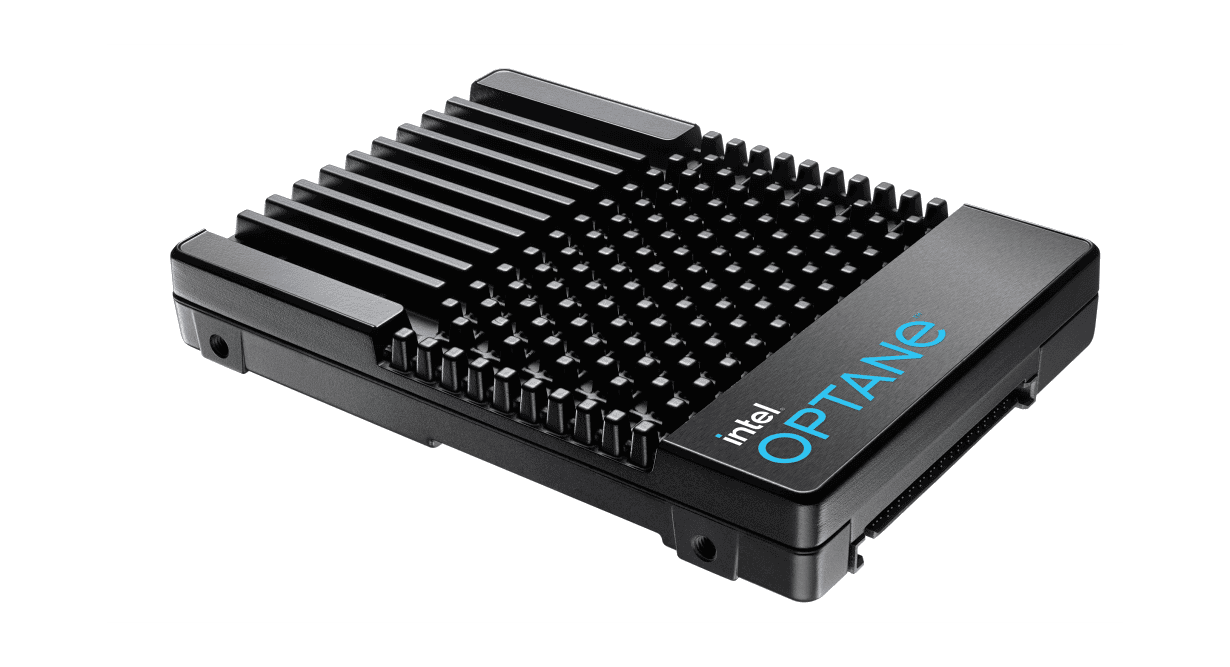
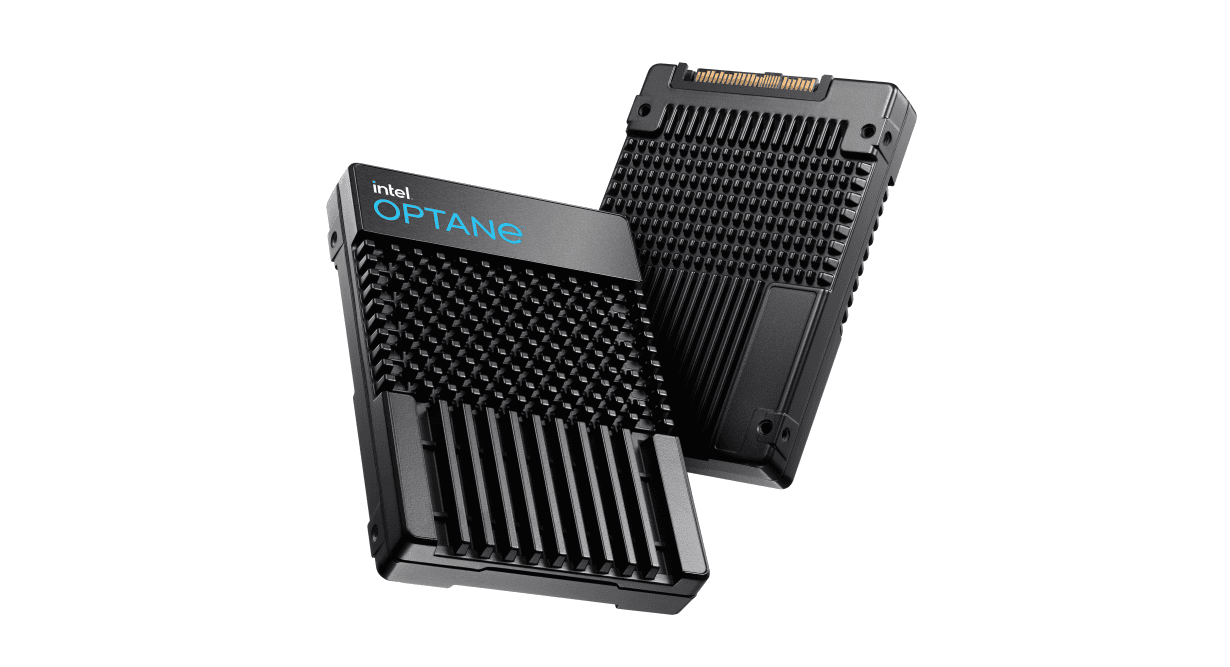
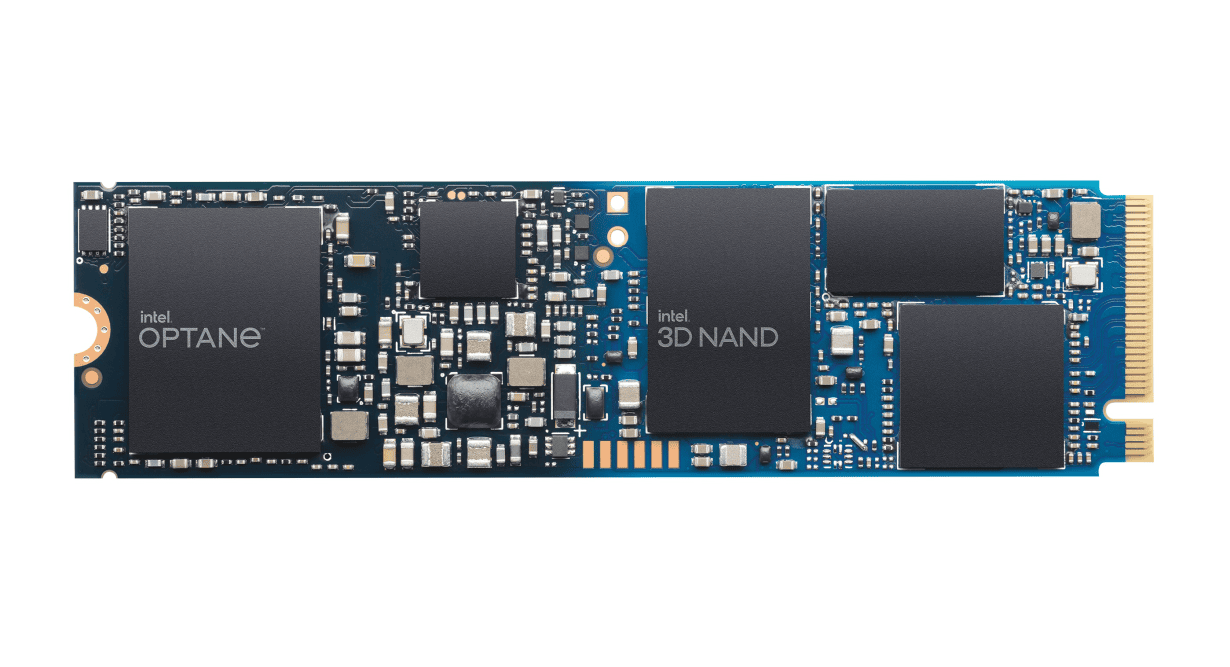
What’s New: Today, at Intel’s Memory and Storage 2020 event, the company highlighted six new memory and storage products to help customers meet the challenges of digital transformation. Key to advancing innovation across memory and storage, Intel announced two new additions to its Intel® Optane™ Solid State Drive (SSD) Series: the Intel® Optane™ SSD P5800X, the world’s fastest data center SSD and the Intel® Optane™ Memory H20 for client, which features performance and mainstream productivity for gaming and content creation. Optane helps meet the needs of modern computing by bringing the memory closer to the CPU. The company also revealed its intent to deliver its 3rd generation of Intel® Optane™ persistent memory (code-named “Crow Pass”) for cloud and enterprise customers.
“Today is a key moment for our memory and storage journey. With the release of these new Optane products, we continue our innovation, strengthen our memory and storage portfolio and enable our customers to better navigate the complexity of digital transformation. Optane products and technologies are becoming a mainstream element of business compute. And as a part of Intel, these leadership products are advancing our long-term growth priorities, including AI, 5G networking and the intelligent, autonomous edge.”
–Alper Ilkbahar, Intel vice president in the Data Platforms Group and general manager of the Intel Optane Group
Why Intel Optane Technology Matters: With today’s Intel Optane technology announcements, Intel continues to establish a new tier in the data center memory and storage pyramid, which combines the attributes of both DRAM and NAND. Intel Optane SSDs alleviate data supply bottlenecks and accelerate applications with fast caching and fast storage to increase scale-per-server and reduce transaction costs for latency-sensitive workloads.
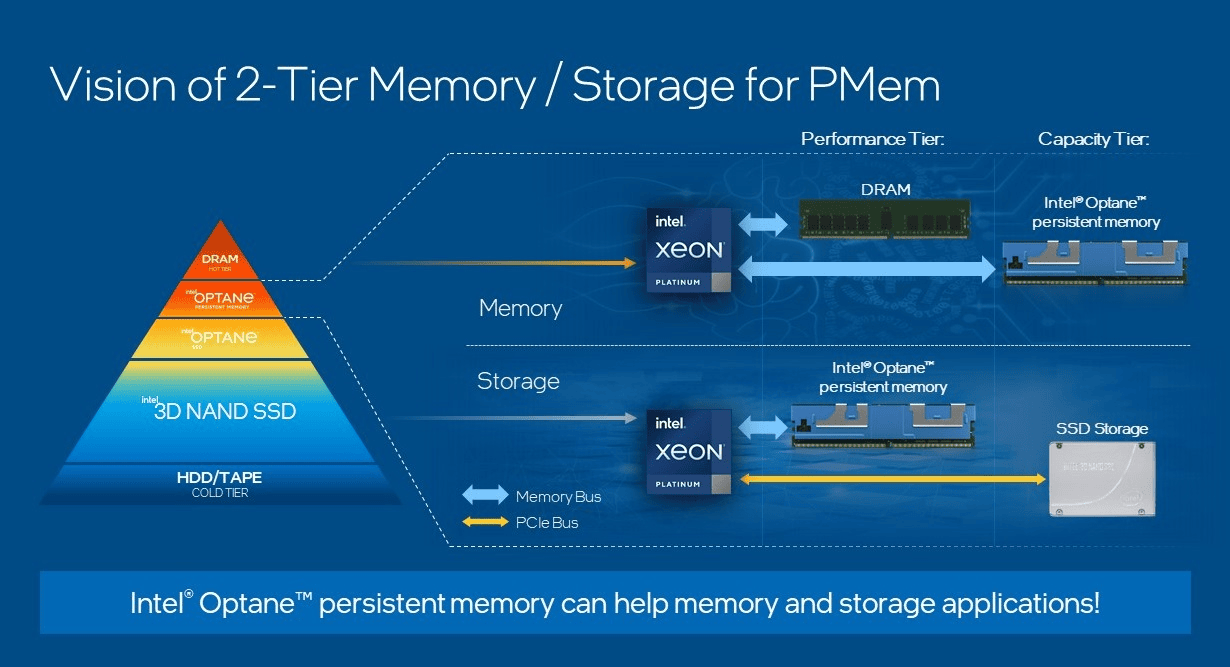
Intel Optane persistent memory is Intel’s vision of a memory and storage solution that offers persistence, capacity, affordability, low latency and memory-like speed. With Intel Optane persistent memory, Intel has re-architected the memory and storage hierarchy allowing it to be used as a distinct capacity and performance tier for memory and storage. With this approach, it is possible to create a two-tiered memory architecture where DRAM is the performance tier and persistent memory is the capacity tier. In the case of storage, Optane persistent memory is used as the performance tier to the NAND capacity tier.
Intel Optane persistent memory is attached to the CPU via the double-data rate bus, enabling direct load-and-store access at DRAM speeds; non-volatile, it combines the best elements of memory and storage.
Intel will further strengthen and extend its unique memory and storage portfolio with its 3rd generation of Intel Optane persistent memory, code-named “Crow Pass” and with future Intel® Xeon® Scalable processors (code-named “Sapphire Rapids.”)
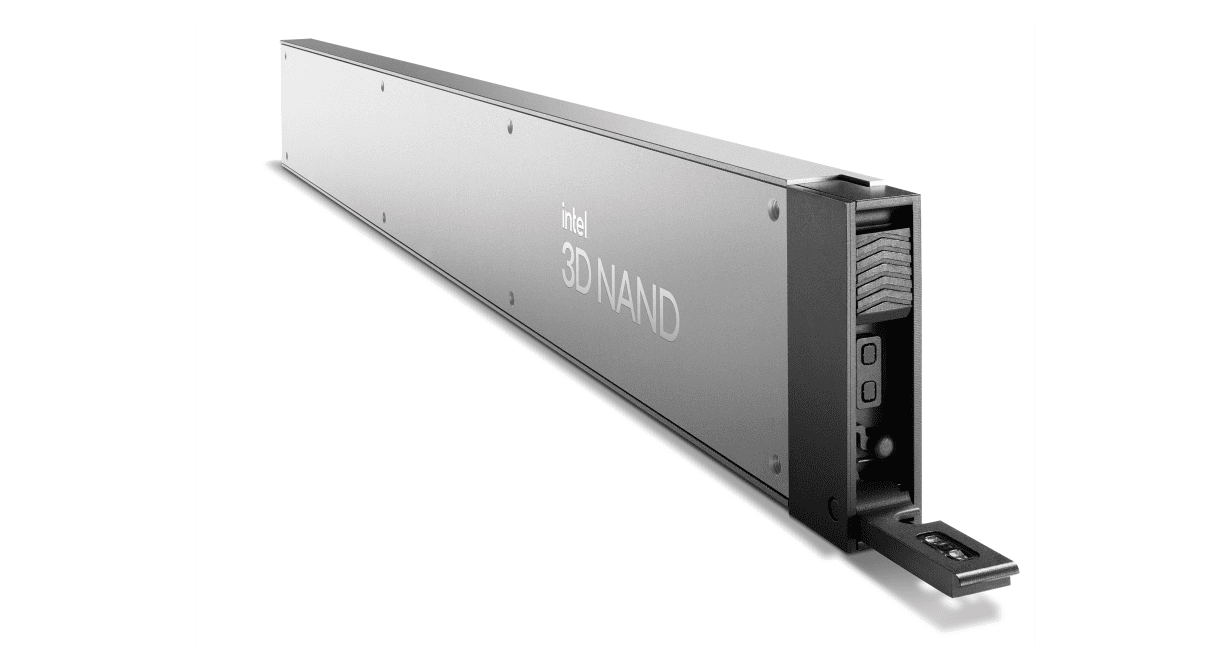
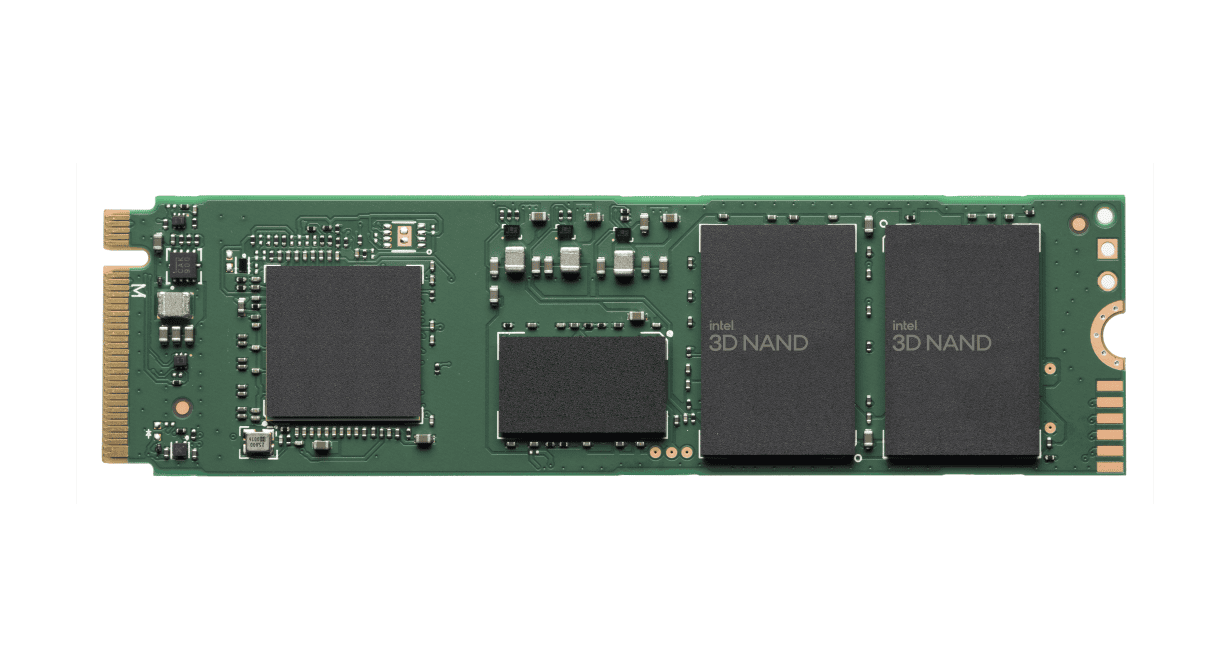
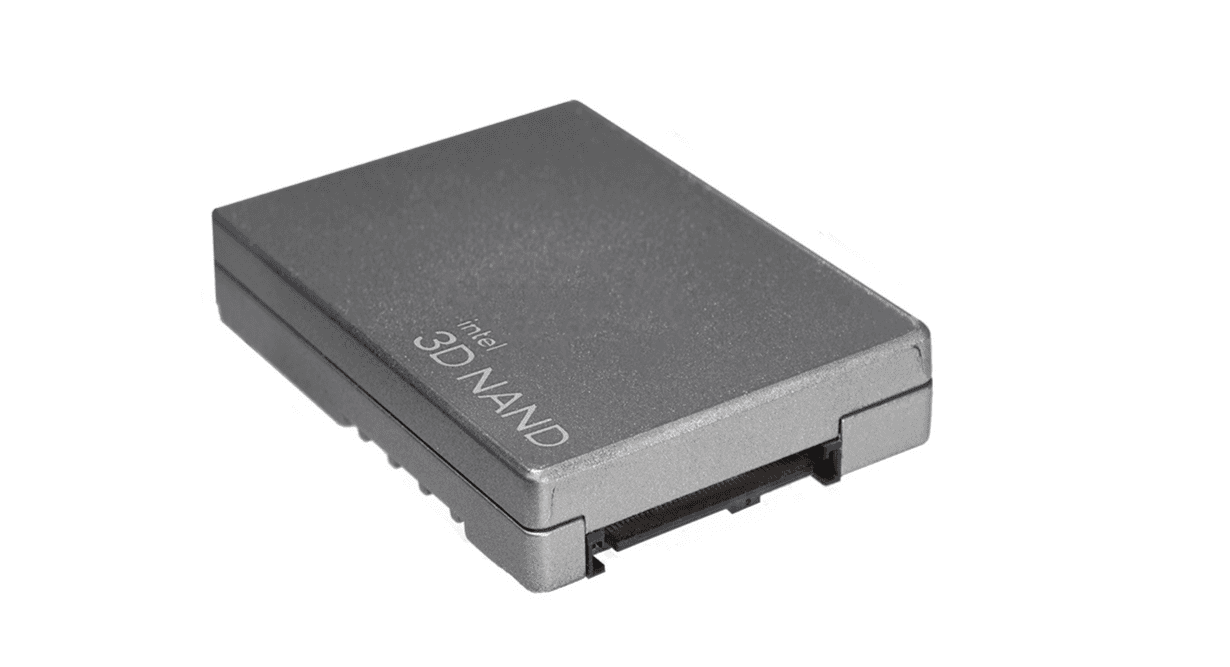
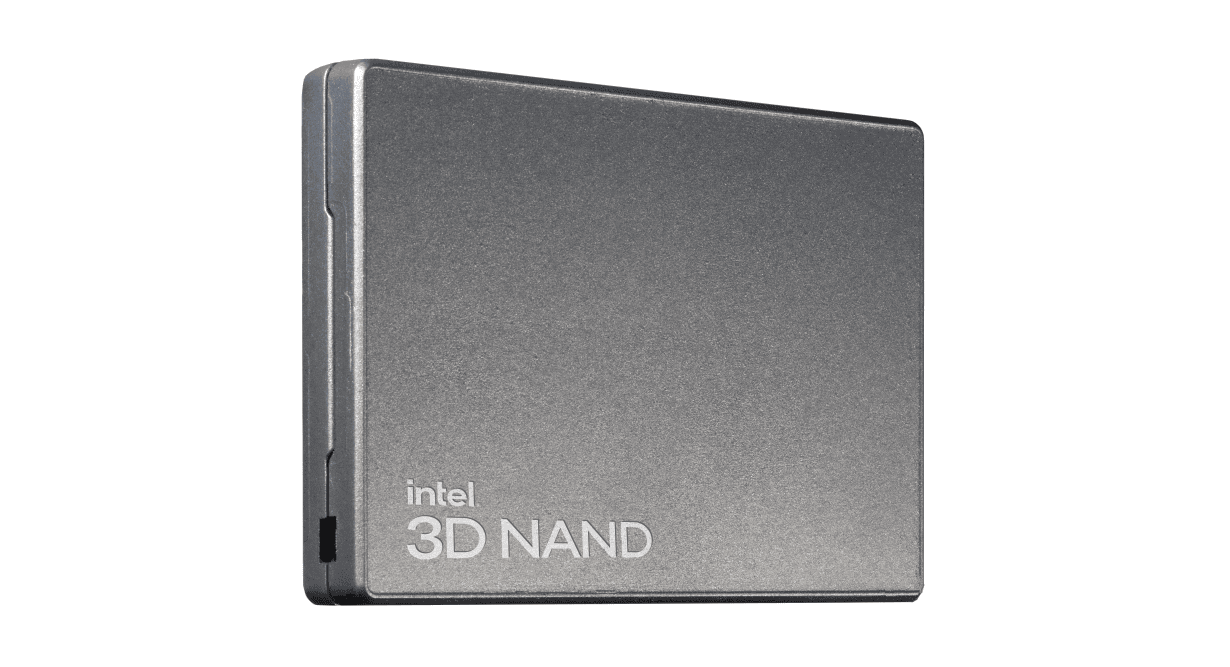
Why 144-layer cell memory NAND Matters: Three new NAND SSDs announced today represent new milestones for establishing TLC and QLC as a mainstream technology for high-capacity drives. The Intel® 3D NAND SSD 670p is Intel’s next-gen 144-layer quad-level-cell (QLC) 3D NAND SSD for mainstream computing. The Intel SSD D7-P5510 is the world’s first-to-market 144-layer TLC NAND design and the Intel SSD D5-P5316 is built around the industry’s first 144-layer QLC NAND. Intel has been developing these technologies over the past decade.
NVIDIA Doubles Down
Announces A100 80GB GPU, Supercharging World’s Most Powerful GPU for AI Supercomputing
NVIDIA unveiled the NVIDIA® A100 80GB GPU, the latest innovation powering the NVIDIA HGX™ AI supercomputing platform, with twice the memory of its predecessor, providing researchers and engineers unprecedented speed and performance to unlock the next wave of AI and scientific breakthroughs.
The new A100 with HBM2e technology doubles the A100 40GB GPU’s high-bandwidth memory to 80GB and delivers over 2 terabytes per second of memory bandwidth. This allows data to be fed quickly to A100, the world’s fastest data center GPU, enabling researchers to accelerate their applications even faster and take on even larger models and datasets.
“Achieving state-of-the-art results in HPC and AI research requires building the biggest models, but these demand more memory capacity and bandwidth than ever before,” said Bryan Catanzaro, vice president of applied deep learning research at NVIDIA. “The A100 80GB GPU provides double the memory of its predecessor, which was introduced just six months ago and breaks the 2TB per second barrier, enabling researchers to tackle the world’s most important scientific and big data challenges.”
The NVIDIA A100 80GB GPU is available in NVIDIA DGX™ A100 and NVIDIA DGX Station™ A100 systems, also announced today and expected to ship this quarter.
Fueling Data-Hungry Workloads
Building on the diverse capabilities of the A100 40GB, the 80GB version is ideal for a wide range of applications with enormous data memory requirements.
For AI training, recommender system models like DLRM have massive tables representing billions of users and billions of products. A100 80GB delivers up to a 3x speedup, so businesses can quickly retrain these models to deliver highly accurate recommendations.
The A100 80GB also enables training of the largest models with more parameters fitting within a single HGX-powered server such as GPT-2, a natural language processing model with superhuman generative text capability. This eliminates the need for data or model parallel architectures that can be time consuming to implement and slow to run across multiple nodes.
With its multi-instance GPU (MIG) technology, A100 can be partitioned into up to seven GPU instances, each with 10GB of memory. This provides secure hardware isolation and maximizes GPU utilization for a variety of smaller workloads. For AI inferencing of automatic speech recognition models like RNN-T, a single A100 80GB MIG instance can service much larger batch sizes, delivering 1.25x higher inference throughput in production.
On a big data analytics benchmark for retail in the terabyte-size range, the A100 80GB boosts performance up to 2x, making it an ideal platform for delivering rapid insights on the largest of datasets. Businesses can make key decisions in real time as data is updated dynamically.
For scientific applications, such as weather forecasting and quantum chemistry, the A100 80GB can deliver massive acceleration. Quantum Espresso, a materials simulation, achieved throughput gains of nearly 2x with a single node of A100 80GB.
“Speedy and ample memory bandwidth and capacity are vital to realizing high performance in supercomputing applications,” said Satoshi Matsuoka, director at RIKEN Center for Computational Science. “The NVIDIA A100 with 80GB of HBM2e GPU memory, providing the world’s fastest 2TB per second of bandwidth, will help deliver a big boost in application performance.”
Key Features of A100 80GB
The A100 80GB includes the many groundbreaking features of the NVIDIA Ampere architecture:
- Third-Generation Tensor Cores: Provide up to 20x AI throughput of the previous Volta generation with a new format TF32, as well as 2.5x FP64 for HPC, 20x INT8 for AI inference and support for the BF16 data format.
- Larger, Faster HBM2e GPU Memory: Doubles the memory capacity and is the first in the industry to offer more than 2TB per second of memory bandwidth.
- MIG technology: Doubles the memory per isolated instance, providing up to seven MIGs with 10GB each.
- Structural Sparsity: Delivers up to a 2x speedup inferencing sparse models.
- Third-Generation NVLink® and NVSwitch™: Provide twice the GPU-to-GPU bandwidth of the previous generation interconnect technology, accelerating data transfers to the GPU for data-intensive workloads to 600 gigabytes per second.
NVIDIA HGX AI Supercomputing Platform
The A100 80GB GPU is a key element in NVIDIA HGX AI supercomputing platform, which brings together the full power of NVIDIA GPUs, NVIDIA NVLink, NVIDIA InfiniBand networking and a fully optimized NVIDIA AI and HPC software stack to provide the highest application performance. It enables researchers and scientists to combine HPC, data analytics and deep learning computing methods to advance scientific progress.
Contact us to purchase NVIDIA A100 80GB GPU